
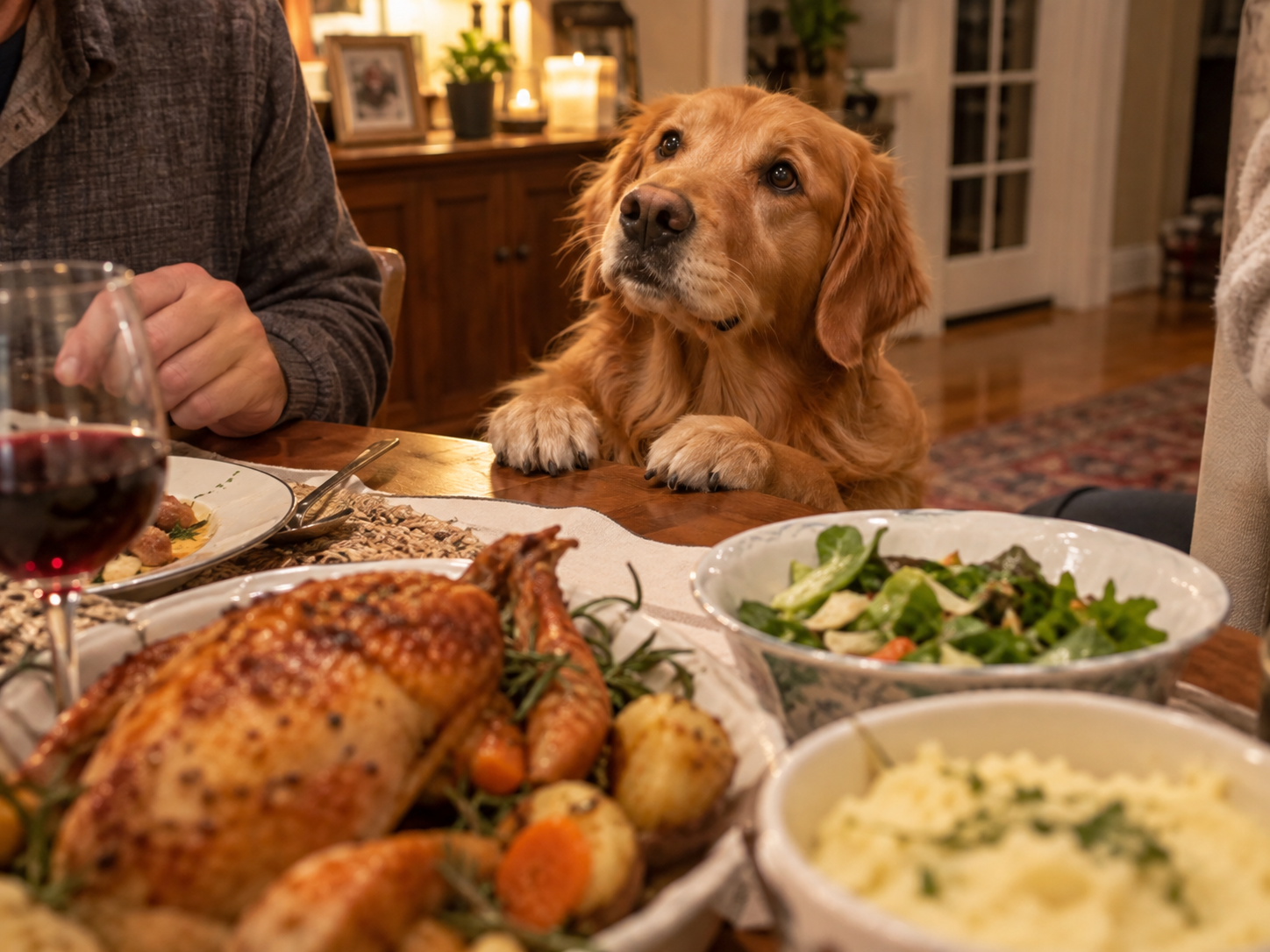
How to Stop Your Dog From Begging for Food at Mealtime
Does your dog stare at you, whine, paw at your leg, or hover around the dinner table every time your family eats? If so, you’re dealing with one of the most common—and frustrating—dog behavior problems: begging for food.
The good news is that dog begging is a behavior that can be changed. With clear expectations, consistency, proper obedience training, and practice, you can teach your dog to remain calm and respectful while your family eats.
At Rich’s Elite Dog Training, in-home dog training focuses on teaching dogs reliable obedience in the environment where everyday behavior problems actually happen. Rich Ehrenberg has more than 35 years of professional dog-training experience and works directly with dogs and their owners throughout Chicago’s North Shore and surrounding communities.
Why Does My Dog Beg for Food?
Most dogs beg because they’ve learned that begging works.
Think about what happens when your dog sits beside the table and stares at you. Eventually, someone may give them a piece of food. From your dog’s perspective, the lesson is simple:
I begged → I got food.
Even if your dog only receives food occasionally, that can be enough to keep the behavior going.
Dogs are also naturally attracted to the smells, sounds, and activity surrounding human meals. When everyone gathers around the table, your dog may see dinner as an opportunity to get attention and, hopefully, a tasty reward.
The key to stopping begging isn’t simply telling your dog “no.” You need to teach your dog what behavior you expect instead.
How to Stop a Dog From Begging at the Table
1. Never Reward Begging
The first step is simple: stop giving your dog food from the dinner table.
This needs to be a family-wide rule.
If one person ignores your dog while another slips them a bite of steak, your dog will continue trying. In fact, inconsistent rewards can make begging especially persistent because your dog learns that asking enough times might eventually pay off.
Make the rule clear:
No food from the table.
This doesn’t mean your dog can’t have treats or meals. It simply means food comes from appropriate places and at appropriate times—not because your dog begged for it.
Consistency is an important part of successful obedience training. Rich’s Elite Dog Training emphasizes clear communication and consistency as part of its approach to developing reliable behavior.
2. Teach Your Dog an Alternative Behavior
Instead of only teaching your dog what not to do, teach them what to do.
Basic commands such as sit, down, and stay can become valuable tools during family meals.
For example, before sitting down for dinner, ask your dog to go to a designated spot. Your dog might lie on a bed or mat a short distance from the table.
Reward calm, appropriate behavior and gradually increase the amount of time your dog remains there.
Eventually, your dog can learn a routine such as:
Dinner starts → I go to my spot → I stay there → Dinner ends → I’m released.
This gives your dog a clear job instead of leaving them to decide how to behave around food.
Rich’s Elite Dog Training works on foundational obedience—including heel, sit, down, stay, and come—and uses progressively more challenging environments and distractions to build reliable behavior.
3. Establish a Designated Dinner Spot
A designated “dinner spot” can make mealtime training much easier.
Choose a comfortable location away from the table. This could be:
- A dog bed
- A mat
- A specific place on the floor
- Another appropriate location in the room
Start practicing when nobody is eating.
Ask your dog to go to the spot and remain there. Once your dog understands the expectation, gradually introduce distractions.
You can then practice while preparing food, setting the table, and eventually eating a complete meal.
The goal isn’t to isolate your dog. It’s to teach your dog that being part of the family doesn’t mean being under the table looking for handouts.
4. Don’t Reward Whining, Pawing, or Staring
Begging doesn’t always look like sitting beside your chair.
Your dog may:
- Whine
- Bark
- Paw at you
- Put their head on your lap
- Stare intensely at your plate
- Nudge your hand
- Walk between family members
- Jump on people
- Try to steal food
If these behaviors result in food or attention, your dog learns that they work.
Instead of repeatedly scolding your dog, calmly redirect them to the behavior you’ve taught.
Clear communication is particularly important when changing an established habit. Rich’s approach centers on consistent communication and training both the dog and owner, rather than relying on a one-size-fits-all program.
5. Practice Dog Obedience Before Dinner
Don’t make the dinner table the first place you expect your dog to demonstrate perfect obedience.
Practice throughout the day.
For example:
- Ask your dog to sit.
- Ask for a stay.
- Take a few steps away.
- Return and reinforce the appropriate behavior.
- Gradually introduce distractions.
- Practice around food when your dog is ready.
The more reliable the behavior becomes in low-distraction situations, the easier it will be to use those commands during dinner.
This is one reason in-home dog training can be particularly useful. Training takes place where your dog’s real-life behaviors occur—not just in an unfamiliar training facility. Rich’s Elite Dog Training conducts private sessions in the home and works with owners as well as their dogs.
6. Make Sure Everyone in the Family Is Consistent
Your dog doesn’t understand why begging is allowed on Tuesday but not Wednesday.
If different family members have different rules, your dog will continue testing them.
Everyone should agree on the same expectations:
- Don’t feed the dog from the table.
- Don’t reward begging.
- Use the same commands.
- Reinforce calm behavior.
- Practice consistently.
The more predictable the rules are, the easier it is for your dog to understand them.
7. Be Patient When Breaking the Habit
If begging has worked for months or years, your dog probably won’t stop after one dinner.
You may even notice that your dog initially tries harder.
That’s normal when a previously rewarded behavior stops producing the desired result.
Stay consistent and continue reinforcing the behavior you want. Over time, your dog can learn that begging isn’t an effective way to get food.
Remember that dog training isn’t a one-time event. Owners need to continue practicing and reinforcing the behaviors their dogs learn.
What If My Dog Still Begs for Food?
If you’ve consistently stopped feeding your dog from the table and your dog still can’t settle during meals, begging may be part of a larger obedience or behavior problem.
For example, your dog may also:
- Jump on people
- Steal food from counters
- Bark excessively
- Ignore basic commands
- Have difficulty staying in one place
- Become overly excited around food
- Struggle with impulse control
In these situations, working with a professional dog trainer can help you address the underlying obedience issues rather than simply trying to stop one behavior.
Why Choose In-Home Dog Training?
One advantage of in-home dog training is that you don’t have to recreate your dog’s problem in an artificial environment.
Your dog can learn appropriate behavior in your actual home, around your furniture, family members, routines, distractions, and other everyday situations.
That’s the philosophy behind Rich’s Elite Dog Training.
Rich Ehrenberg provides private, mobile dog training throughout Chicago’s North Shore and surrounding communities. His programs are customized to the individual dog, family, and lifestyle rather than relying on a cookie-cutter approach.
Rich has more than 35 years of professional dog-training experience and previously worked as a Veterinary Technician, bringing extensive knowledge of canine behavior to his training programs.
Stop Dog Begging and Enjoy Mealtime Again
You shouldn’t have to choose between enjoying dinner and managing your dog’s behavior.
With clear expectations, consistent training, and practice, your dog can learn that family mealtime is a time to relax—not a time to beg for scraps.
If your dog’s begging is part of a bigger obedience challenge, professional training can make the process easier and more effective.
Ready to Improve Your Dog’s Behavior?
If you’re looking for in-home dog training in Chicago’s North Shore, Rich’s Elite Dog Training can help you build better communication and more reliable obedience right in your home.
Rich works with puppies, adult dogs, and dogs with established behavior problems, creating customized training programs based on each dog’s needs and your family’s lifestyle.
Don’t spend another dinner telling your dog to get down. Get professional help and teach your dog what you want them to do instead.
Call Rich’s Elite Dog Training at (847) 489-0015 to schedule a free consultation and take the first step toward a better-behaved dog.
Frequently Asked Questions About Dog Begging
How do I stop my dog from begging for food?
Stop rewarding begging and teach an alternative behavior such as going to a designated spot and staying there during meals. Consistency is essential—everyone in the household should follow the same rules.
Should I ignore my dog when they beg for food?
Avoid rewarding begging with food or attention. Instead, calmly redirect your dog to an appropriate behavior you’ve already trained, such as sitting, lying down, or staying in a designated location.
Why does my dog keep begging even though I don’t give them food?
If your dog has been rewarded for begging in the past, the behavior can take time to disappear. Other family members or visitors may also be unintentionally rewarding it. Consistency from everyone is important.
Can dog training stop begging at the dinner table?
Yes. Begging can be addressed through obedience training, particularly when you teach your dog reliable commands and an alternative behavior to perform during meals.
Is in-home dog training effective for begging?
In-home training allows the trainer to work with your dog in the environment where the behavior occurs. Rich’s Elite Dog Training provides mobile, private training in the home, allowing training to be customized around the dog’s behavior and the family’s lifestyle.
Can an older dog learn to stop begging?
Yes. Dogs can learn new behaviors at any age. The approach and pace may vary depending on the dog’s history, temperament, and existing habits, which is why individualized training can be helpful.
Does Rich’s Elite Dog Training serve the Chicago North Shore?
Yes. Rich’s Elite Dog Training provides mobile, in-home dog training throughout Chicago’s North Shore and surrounding communities, including Deerfield, Lake Forest, Highland Park, Glencoe, Glenview, Wilmette, Winnetka, Barrington, Buffalo Grove, Hawthorn Woods, Mundelein, Vernon Hills, Libertyville, Lincolnshire, and surrounding areas.

Door Bolting: How to Keep Your Dog Safe When the Door Opens
Does your dog rush the door the moment someone reaches for the handle? Door bolting may look like excitement, but it can quickly become a serious safety issue. A dog that darts through an open front door can run into traffic, get lost, approach another dog, or put...

How to Stop Your Dog From Jumping on People
A dog jumping up to greet you can seem cute when they’re a small puppy. But once that puppy grows into a full-sized adult dog, the same enthusiastic greeting can become frustrating, embarrassing, and even unsafe. Jumping is one of the common behavior problems dog...
How to Stop Your Dog from Counter Surfing for Good
If you’ve ever turned your back for just a second only to find your dinner missing from the kitchen counter, you’re not alone. Counter surfing is one of the most common behavior problems dog owners face, and unfortunately, it’s also one of the easiest habits for dogs...

The Complete Guide to Housebreaking Your Puppy
Bringing home a new puppy is exciting — but let’s be honest, housebreaking can quickly test your patience. The good news? With consistency, structure, and the right approach, most puppies can learn proper bathroom habits much faster than owners expect. At Elite Dog...

Puppy Biting: Why It Happens and How to Stop It
If you’ve recently brought home a puppy, you’ve probably discovered one thing very quickly: puppies love to bite. Hands, ankles, sleeves, shoelaces, furniture — nothing seems off limits. While puppy biting can feel frustrating (and painful), it’s actually a normal...

The Importance Of Following Breed-Specific Advice
Different breeds have different personalities and respond to in-home dog training techniques in different ways. Therefore, if you are planning to buy more than one dog or if you happen to prefer having dogs of different breeds, I strongly suggest that you look for an...

Basic Training Commands
Some of the most basic and important dog obedience commands are "heel", "sit", "stay", "down", "come", and "drop it". These may seem like very simple commands, but they are more than just cute little tricks. They are actually the keys to controlling your dog’s daily...

Dog Biting
Amongst the most feared and dangerous dog behaviors is “Biting.” Even the most aggressive dog can be trained to improve its behavior considerably. However, To successfully deal with dog biting problems, finding out how the behavior began will be necessary. The best...

Home Dog Training vs. Obedience School
What is so important about in-home dog training? Couldn’t you just send your dog to obedience school? Technically, you DO have a choice of enrolling your dog in obedience school. But, as more and more satisfied owners discover, training conducted in the home...

Dog Training Tips To Stop Dog Jumping
Too often, owners are the cause of the bad behavior known as “Jumping Up.” From the puppy stage to adulthood, many puppies are allowed to jump up and be petted and loved. Then, the puppy grows into a full-sized adult that knocks you off your feet whenever it greets...
